Float and Board Level Gauge Working Principle: Complete Guide for Industrial Tank Level Measurement
Accurate liquid level measurement in tanks is critical for many industries, including oil and gas, chemical processing, water treatment, and power generation. Monitoring tank levels helps ensure operational safety, prevents overflow, and improves inventory management.
One of the most reliable mechanical devices used for this purpose is the Float and Board Level Gauge. Known for its simple design and dependable performance, this device has been widely used in large storage tanks for decades.
This guide explains the float and board level gauge working principle, its components, applications, and why industries still rely on this system for tank level measurement even in the era of advanced electronic sensors.
What is a Float and Board Level Gauge?
A Float and Board Level Gauge (F&BLG) is a mechanical instrument used to visually indicate the level of liquid stored in large tanks. The device operates by placing a float on the liquid surface. As the liquid level changes, the float moves up or down, and this movement is transferred to an external indicator board.
This system allows operators to monitor tank levels without opening the tank or using complex electronics.
Because of its reliability and cost efficiency, the float level gauge is commonly installed in atmospheric storage tanks where continuous level monitoring is required.
Float and Board Level Gauge Working Principle
The float and board level gauge working principle is based on the buoyancy principle, which states that an object floating in a liquid will rise and fall according to the liquid level.
In simple terms, the system converts vertical movement of the float into a visible reading on an external board.
Step-by-Step Working Process
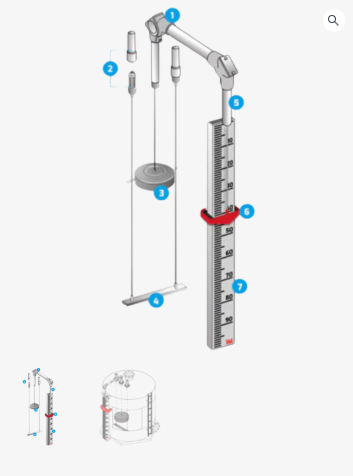
- A float rests on the surface of the liquid inside the tank.
- The float is connected to a stainless steel wire or perforated tape.
- This wire passes through guide pulleys mounted on the tank roof.
- The movement of the float rotates the pulley system.
- The pulley transfers the motion to an indicator connected to a calibrated board outside the tank.
- As the liquid level rises or falls, the indicator moves along the board scale to display the current level.
This mechanical system provides continuous liquid level measurement in tanks without requiring electricity or electronic sensors.
Main Components of a Float Level Gauge
Understanding the components helps explain how the device works reliably in industrial environments.
Float
The float is the main sensing element. It stays on the surface of the liquid and moves according to the liquid level.
Floats are typically made from:
- Stainless steel
- Aluminum
- Corrosion-resistant alloys
These materials ensure durability and long-term performance.
Float Wire or Tape
The float is connected to a stainless steel wire or tape that transmits its movement to the pulley system. The wire must be strong, corrosion-resistant, and flexible to maintain smooth operation.
Guide Pulleys
Guide pulleys help direct the wire movement and reduce friction. They are installed on the top of the storage tank and ensure that the motion of the float is transferred accurately.
Counterweight
A counterweight maintains proper tension in the wire. It balances the system and ensures the indicator moves smoothly when the liquid level changes.
Indicator Board
The indicator board is mounted outside the tank and displays the liquid level. The board is marked with calibrated measurements such as meters, centimeters, or percentage levels.
Operators can quickly read the tank level from a distance using this visual indicator.
Float and Board Level Gauge Diagram and Working
In most installations, the float level indicator in storage tanks follows a simple mechanical layout:
- The float inside the tank moves with the liquid surface.
- A wire connected to the float passes through pulleys.
- The pulleys transmit motion to an indicator on a vertical board.
Because of this straightforward design, the system is easy to install and maintain.
This configuration is commonly used as a mechanical level gauge for storage tanks, especially in large industrial tank farms.
Applications of Float Level Gauges
The float type level gauge working principle makes it suitable for a wide range of industries.
Oil and Gas Industry
Large petroleum storage tanks often use float level gauges to monitor crude oil levels. These devices provide reliable readings even in harsh industrial environments.
Water Treatment Plants
Water reservoirs and storage tanks frequently use float level indicators to track water levels and prevent overflow.
Chemical Industry
Certain chemical storage tanks use float level gauges for continuous level monitoring, especially when electronic sensors are not required.
Power Plants
Fuel storage tanks and cooling water tanks in power plants often rely on float level indicators.
Advantages of Float Level Gauges
Despite the availability of advanced level sensors, float level gauges remain widely used due to several advantages.
Simple and Reliable
The system uses a purely mechanical design, reducing the chances of electronic failure.
Low Maintenance
Compared to digital sensors, float level gauges require minimal maintenance and fewer replacement parts.
Cost Effective
The installation cost of a tank level measurement system using float gauges is significantly lower than advanced level transmitters.
Easy Visual Monitoring
Operators can easily read the tank level from a distance using the external indicator board.
Limitations of Float Level Gauges
While reliable, this system also has some limitations.
- Not suitable for high-pressure tanks
- Performance may decrease with very viscous liquids
- Mechanical components may require periodic inspection
- Not ideal for highly corrosive liquids without special materials
Because of these limitations, some industries combine mechanical level gauges with digital monitoring systems.
Float Level Gauge vs Modern Level Measurement Technologies
Modern industries often use advanced level measurement systems such as:
- radar level transmitters
- ultrasonic level sensors
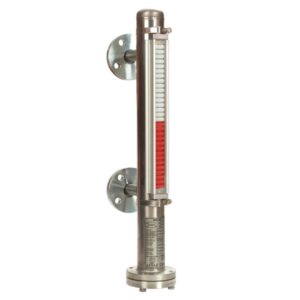
- magnetic level indicators
However, many facilities still keep mechanical float level indicators as backup systems because they are simple and dependable.
Using both systems together improves reliability and ensures continuous monitoring even during electronic failures.
Maintenance Tips for Float Level Gauges
Regular maintenance helps ensure accurate tank level monitoring.
Recommended practices include:
- Inspecting the float for damage or corrosion
- Checking wire tension and alignment
- Lubricating pulleys periodically
- Verifying calibration of the indicator board
Routine inspections help prevent measurement errors and improve system lifespan.
Conclusion
The float and board level gauge working principle demonstrates how a simple mechanical design can provide reliable liquid level measurement in tanks. By using the buoyancy principle and a pulley-based transmission system, the device accurately converts float movement into a visible level reading.
Even with modern sensor technologies available today, the float level gauge remains a trusted solution in many industries because of its durability, low maintenance requirements, and cost efficiency.
For facilities managing large tanks, this classic tank level measurement system continues to play an important role in safe and efficient operations.
If you’re struggling to find the right Float and Board Level Gauge for your storage tanks, Contact our team