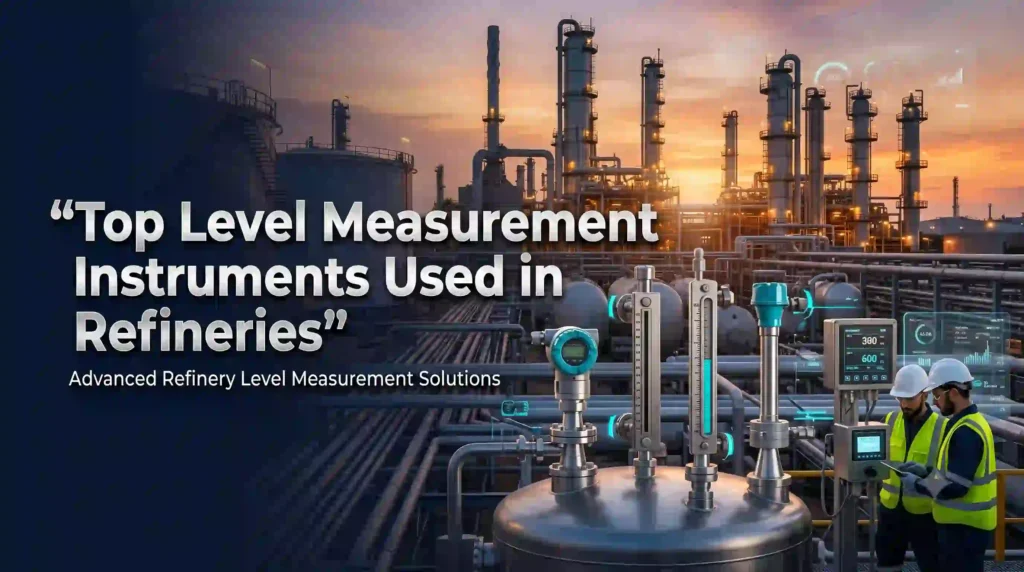
Top Level Measurement Instruments Used in Refineries
In modern refinery operations, accurate level measurement is essential for maintaining process safety, operational efficiency, inventory management, and regulatory compliance. From crude oil storage tanks to high-pressure process vessels, refineries depend on reliable instrumentation systems to ensure continuous and stable production.
Selecting the right level measurement technology can significantly reduce downtime, improve process visibility, and prevent hazardous situations such as tank overflows, dry running, and process instability.
As refinery environments involve extreme temperatures, corrosive chemicals, vapors, pressure variations, and hazardous zones, industries rely on advanced instrumentation solutions engineered specifically for demanding process conditions. This is why understanding the Top Level Measurement Instruments Used in Refineries is critical for refinery engineers, instrumentation professionals, and industrial procurement teams.
Why Refineries Need Advanced Level Measurement Instruments
Refineries operate in some of the harshest industrial environments. Standard measurement devices often fail to deliver reliable performance under these conditions.
Extreme Operating Temperatures
Refinery tanks and process vessels frequently handle high-temperature hydrocarbons, steam systems, and heated oils. Instruments must withstand thermal stress while maintaining accuracy.
Corrosive and Hazardous Chemicals
Aggressive media such as acids, sulfur compounds, and petroleum products require corrosion-resistant materials and robust sensor technologies.
Pressurized Storage and Process Tanks
Many refinery applications involve pressurized vessels where accurate level monitoring is essential for process safety.
Need for Continuous Process Automation
Modern refineries integrate instrumentation with DCS, PLC, and SCADA systems for real-time monitoring and operational control.
Inventory and Safety Compliance
Precise tank level monitoring helps improve inventory tracking, environmental compliance, and production planning.
Because of these operational challenges, industries increasingly invest in the Top Level Measurement Instruments Used in Refineries to improve reliability and process performance.
Top Level Measurement Instruments Used in Refineries
1. Radar Level Transmitters
Radar level transmitters are among the most widely used refinery level measurement technologies.
Working Principle
These instruments transmit microwave signals toward the product surface and calculate level based on signal reflection time.
Key Features
- Non-contact measurement
- High accuracy
- Excellent performance in vapor environments
- Suitable for high temperature and pressure applications
Advantages
- Minimal maintenance
- Reliable continuous level measurement
- Excellent for hazardous area applications
- High operational stability
Limitations
- Higher initial investment
- Proper antenna selection required
Best Refinery Applications
- Crude oil tanks
- Fuel storage systems
- Petrochemical vessels
- Asphalt tanks
Radar systems continue to rank among the Top Level Measurement Instruments Used in Refineries because of their long-term reliability in difficult process conditions.
2. Guided Wave Radar Level Transmitters
Guided wave radar (GWR) instruments use a probe to guide microwave pulses directly to the liquid surface.
Working Principle
The microwave signal travels along the probe and reflects when it reaches the process media.
Key Features
- High measurement precision
- Suitable for interface level measurement
- Stable readings in turbulent conditions
Advantages
- Resistant to vapor interference
- Effective in foam applications
- Excellent repeatability
Limitations
- Probe build-up may affect performance
- Requires contact with process fluid
Best Applications
- Separator vessels
- Interface monitoring
- Process reactors
- Pressurized tanks
These systems are widely considered one of the Top Level Measurement Instruments Used in Refineries for critical process applications.
3. Ultrasonic Level Sensors
Ultrasonic sensors measure liquid levels using sound wave technology.
Working Principle
The sensor emits ultrasonic pulses and measures the echo return time from the liquid surface.
Key Features
- Non-contact measurement
- Cost-effective solution
- Easy installation
Advantages
- Low maintenance
- Suitable for open tank applications
- Good for utility systems
Limitations
- Affected by vapor and temperature fluctuations
- Less suitable for high-pressure environments
Best Applications
- Water treatment tanks
- Utility systems
- Wastewater applications
Ultrasonic devices remain part of the Top Level Measurement Instruments Used in Refineries for non-critical and auxiliary applications.
4. Differential Pressure Level Transmitters
Differential pressure transmitters use hydrostatic pressure principles for level measurement.
Working Principle
The pressure difference between the bottom and top of the vessel is used to calculate liquid level.
Key Features
- Proven industrial technology
- Reliable under pressure
- Suitable for closed tanks
Advantages
- Economical solution
- Widely used across industries
- Suitable for high-pressure vessels
Limitations
- Density variations affect accuracy
- Requires impulse line maintenance
Best Applications
- Boiler drums
- Reactor vessels
- Process columns
DP transmitters remain among the Top Level Measurement Instruments Used in Refineries due to their cost-effectiveness and industrial reliability.
5. Magnetic Level Gauges
Magnetic level gauges provide direct visual level indication and are extensively used in oil and gas industries. Globe United manufactures magnetic level gauges designed for high-pressure and high-temperature applications.
Working Principle
A float containing a magnetic assembly moves with the liquid level inside a chamber. External indicators display the level visually.
Key Features
- Clear local indication
- Suitable for hazardous environments
- Low maintenance
Advantages
- Reliable visual monitoring
- Suitable for corrosive media
- Long operational lifespan
Limitations
- Mechanical float required
- May not provide ultra-high precision
Best Applications
- Process vessels
- Chemical tanks
- High-pressure storage systems
Magnetic gauges are considered one of the practical Top Level Measurement Instruments Used in Refineries where local visual indication is essential.
6. Reflex and Transparent Level Gauges
Reflex and transparent gaugesare widely used for direct liquid level observation in industrial process systems. Globe United manufactures these gauges for refinery, petrochemical, and power applications.
Working Principle
These gauges use specialized glass chambers to provide direct visual observation of liquid levels.
Key Features
- Real-time visual monitoring
- Suitable for high-pressure systems
- High-temperature compatibility
Advantages
- Simple operation
- Reliable visual confirmation
- No external power required
Limitations
- Requires periodic maintenance
- Glass components need inspection
Best Applications
- Steam systems
- Boiler applications
- Petrochemical vessels
7. Float and Board Type Level Gauges
Float and board systems provide continuous mechanical level indication for large storage tanks.
Working Principle
A float connected to a mechanical indicator tracks liquid movement inside the tank.
Key Features
- Simple design
- No electrical power required
- Suitable for large tanks
Advantages
- Cost-effective
- Easy maintenance
- Reliable outdoor operation
Limitations
- Limited automation capability
- Lower precision than electronic systems
Best Applications
- Crude oil storage tanks
- Water storage systems
- Bulk liquid tanks
Globe United manufactures float and board type gauges for industrial storage applications.
8. Nuclear Level Measurement Systems
Nuclear systems are designed for the most extreme refinery environments.
Working Principle
Gamma radiation absorption is used to determine process level externally.
Key Features
- Non-invasive measurement
- Suitable for extreme conditions
- External installation possible
Advantages
- Works under extreme pressure and temperature
- No direct process contact
- Suitable for highly corrosive environments
Limitations
- Regulatory compliance required
- Higher installation cost
Best Applications
- Coke drums
- Reactor systems
- Severe process environments
These remain among the specialized Top Level Measurement Instruments Used in Refineries for highly demanding applications.
Comparison Table of Refinery Level Measurement Instruments
Instrument Type | Accuracy | Temperature Handling | Pressure Handling | Maintenance | Best Applications | Cost |
Radar Level Transmitter | Very High | Excellent | Excellent | Low | Crude oil tanks | High |
Guided Wave Radar | Very High | Excellent | Excellent | Medium | Separator vessels | High |
Ultrasonic Sensor | Medium | Moderate | Low | Low | Utility tanks | Low |
Differential Pressure | Medium | High | High | Medium | Closed vessels | Medium |
High | Excellent | Excellent | Low | Process vessels | Medium | |
Medium | High | High | Medium | Steam systems | Medium | |
Float & Board Gauge | Moderate | Moderate | Moderate | Low | Storage tanks | Low |
Nuclear System | High | Extreme | Extreme | Low | Coke drums | Very High |
How to Choose the Right Level Measurement Instrument for Refineries
Selecting the right instrument depends on process requirements and operating conditions.
Consider Tank Design
Open tanks, pressurized vessels, and interface applications require different technologies.
Evaluate Process Conditions
Temperature, pressure, viscosity, and vapor presence affect instrument performance.
Analyze Chemical Compatibility
Corrosive chemicals may require specialized metallurgy such as SS316, Hastelloy, or PTFE-lined components.
Review Installation Requirements
Some applications require non-contact measurement, while others require local visual indication.
Consider Hazardous Area Certifications
Explosion-proof and intrinsically safe certifications are essential in oil and gas applications.
Choosing from the Top Level Measurement Instruments Used in Refineries requires balancing operational reliability, maintenance requirements, and long-term performance.
Common Problems in Refinery Level Measurement
Foam Formation
Foam can interfere with ultrasonic measurements and create unstable readings.
Solution
Guided wave radar technologies reduce foam-related signal disturbances.
Vapor Interference
Heavy hydrocarbon vapors affect certain sensor technologies.
Solution
Radar-based systems operate reliably in vapor-rich environments.
Corrosion
Aggressive process chemicals damage conventional sensors.
Solution
Use corrosion-resistant materials and external chamber systems.
Signal Instability
Turbulence and process agitation reduce measurement accuracy.
Solution
Stilling wells and advanced signal filtering improve stability.
High Pressure Conditions
Extreme pressure environments challenge standard instruments.
Solution
Magnetic gauges, radar transmitters, and nuclear systems provide reliable operation under pressure.
Future Trends in Refinery Level Measurement Technology
The future of refinery instrumentation focuses on intelligent automation and digital process monitoring.
Smart Instrumentation
Modern transmitters now provide diagnostics, predictive alerts, and digital communication.
IIoT Integration
Industrial Internet of Things systems enable centralized refinery monitoring.
Predictive Maintenance
Advanced diagnostics reduce unexpected failures and downtime.
Wireless Monitoring
Wireless instrumentation improves installation flexibility.
AI-Based Diagnostics
Artificial intelligence enhances process optimization and equipment reliability.
The next generation of the Top Level Measurement Instruments Used in Refineries will focus heavily on real-time analytics and remote operational visibility.
Conclusion
Reliable level measurement is critical for refinery safety, operational efficiency, inventory management, and process automation. From advanced radar transmitters to magnetic level gauges and transparent level indicators, each technology offers unique benefits depending on process conditions and application requirements.
Understanding the Top Level Measurement Instruments Used in Refineries helps industries improve process reliability, reduce downtime, and enhance plant safety.
As a trusted manufacturer and supplier of industrial instrumentation solutions, Globe United delivers high-quality level measurement systems designed for demanding refinery and oil & gas applications. Their product range includes magnetic level gauges, reflex level gauges, transparent level gauges, float and board systems, and process instrumentation accessories engineered for industrial reliability.
Looking for Reliable Refinery Instrumentation Solutions?
Globe United provides high-performance level measurement and process instrumentation solutions for oil & gas, petrochemical, power, and industrial applications across the UAE and global markets.
Contact Globe United today to discuss customized refinery instrumentation solutions tailored to your operational requirements.