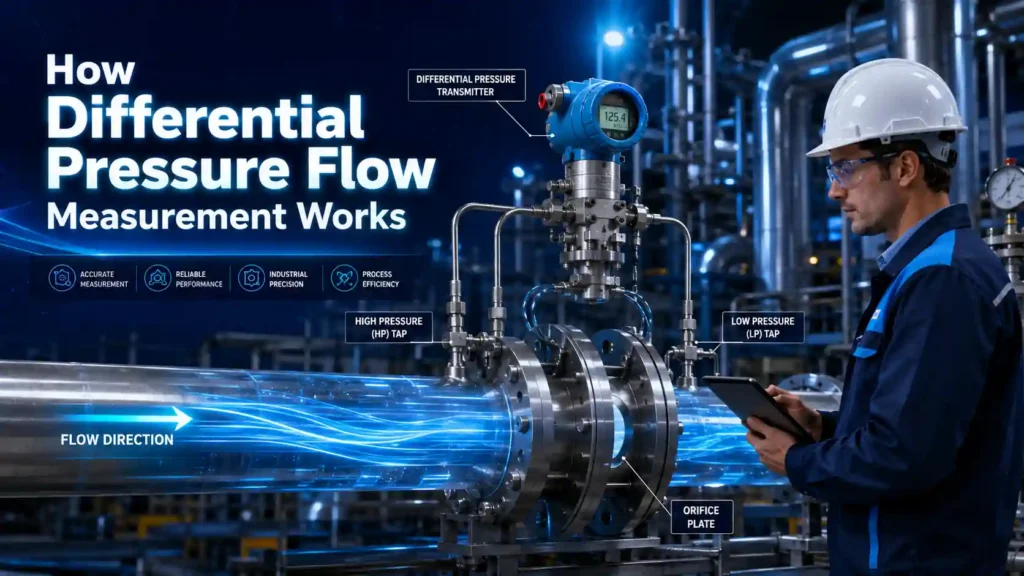
How Differential Pressure Flow Measurement Works
In modern industrial processes, accurate flow measurement is essential for maintaining efficiency, safety, and process control. Industries such as oil & gas, chemical processing, power generation, water treatment, and manufacturing all rely heavily on reliable flow monitoring systems. Among the many available technologies, differential pressure (DP) flow measurement remains one of the most widely used and trusted methods.
Differential pressure flow measurement is popular because of its simple operating principle, cost-effectiveness, reliability, and ability to handle liquids, gases, and steam applications. Understanding how this technology works helps engineers select the right instrumentation for industrial operations.
What is Differential Pressure Flow Measurement?
Differential pressure flow measurement is a method used to determine the flow rate of a fluid by measuring the pressure drop across a restriction installed inside a pipeline.
The principle is based on Bernoulli’s equation and the continuity equation. When fluid passes through a narrowed section of a pipe, its velocity increases while the pressure decreases. By measuring the pressure difference between the upstream and downstream sides of the restriction, the flow rate can be calculated.
The restriction element is commonly called the primary element, while the instrument that measures the pressure difference is known as the differential pressure transmitter.
Basic Working Principle
The working principle of differential pressure flow measurement is based on fluid dynamics.
When a fluid flows through a pipe with a restriction such as an orifice plate, venturi tube, or flow nozzle, the flow area decreases. Since the same quantity of fluid must continue flowing through the pipe, the fluid velocity increases at the restricted section.
According to Bernoulli’s principle:
P + \frac{1}{2}\rho v^2 + \rho gh = constant
This equation states that the total energy of a flowing fluid remains constant. As velocity increases, pressure decreases.
The pressure difference created across the restriction is directly related to the flow rate. Higher flow creates a larger pressure drop.
The general flow equation is:
Q = C A \sqrt{\frac{\Delta P}{\rho}}
Where:
- Q = Flow rate
- C = Discharge coefficient
- A = Area of restriction
- ΔP = Differential pressure
- ρ = Fluid density
This equation shows that flow rate is proportional to the square root of the differential pressure.
Main Components of a Differential Pressure Flow Measurement System
A complete DP flow measurement system typically consists of three main components.
1. Primary Element
The primary element creates the restriction inside the pipeline that generates the pressure drop.
Common primary elements include:
Orifice Plate
A thin metal plate with a hole in the center. This is the most commonly used DP flow element because of its low cost and simple installation.
Venturi Tube
A specially designed tube with a smooth converging and diverging section. It produces lower pressure loss and higher accuracy.
Flow Nozzle
Used mainly in high-velocity steam applications and power plants.
Pitot Tube
Measures velocity by comparing static and dynamic pressure.
Wedge Meter
Suitable for dirty fluids, slurries, and viscous liquids.
2. Pressure Taps
Pressure taps are installed before and after the restriction element to measure upstream and downstream pressure.
These taps are connected to impulse lines that transmit pressure signals to the differential pressure transmitter.
3. Differential Pressure Transmitter
The DP transmitter measures the pressure difference between the two pressure taps and converts it into an electrical signal.
Modern smart transmitters can:
- Perform square root extraction
- Provide digital communication
- Enable remote monitoring
- Improve measurement accuracy
Step-by-Step Working Process
Step 1: Fluid Enters the Pipe
The fluid flows normally through the pipeline at a certain pressure and velocity.
Step 2: Fluid Reaches the Restriction
As the fluid encounters the orifice plate or venturi tube, the flow area decreases.
Because of the reduced area:
- Fluid velocity increases
- Static pressure decreases
This creates a measurable pressure drop.
Step 3: Pressure Difference is Measured
Pressure taps located upstream and downstream measure:
- High pressure side
- Low pressure side
The DP transmitter calculates the difference between them.
Step 4: Flow Rate is Calculated
Using calibrated formulas based on Bernoulli’s equation, the system converts differential pressure into flow rate.
Because flow is proportional to the square root of pressure difference:
- Small pressure changes represent large flow changes
- Accurate calibration is important
Why Differential Pressure Increases with Flow
One of the most important concepts in DP flow measurement is the square-root relationship.
If flow doubles, differential pressure does not double. Instead:
Q \propto \sqrt{\Delta P}
This means:
- 4 times pressure difference = 2 times flow
- 9 times pressure difference = 3 times flow
This relationship is critical during transmitter calibration and signal processing.
Advantages of Differential Pressure Flow Measurement
1. Cost-Effective
DP flow systems are generally less expensive compared to advanced flow technologies.
2. Widely Accepted Standard
Differential pressure flow measurement follows international standards such as ISO 5167.
3. Suitable for High Temperature and Pressure
These systems work effectively in harsh industrial environments.
4. Versatile
They can measure:
- Liquids
- Gases
- Steam
5. Easy Maintenance
Most components are simple and easy to replace.
Limitations of Differential Pressure Flow Measurement
Despite its popularity, DP flow measurement also has some limitations.
Permanent Pressure Loss
The restriction creates energy loss inside the pipeline.
Reduced Accuracy at Low Flow
Accuracy decreases at very low flow rates.
Sensitivity to Installation
Incorrect pipe straight lengths can affect readings.
Requires Calibration
Proper sizing and calibration are essential for reliable results.
Common Industrial Applications
Differential pressure flow measurement is widely used across industries.
Oil & Gas Industry
- Natural gas flow measurement
- Refinery process monitoring
- Custody transfer systems
Power Plants
- Steam flow measurement
- Boiler feedwater systems
Chemical Industry
- Chemical dosing systems
- Process flow monitoring
Water Treatment Plants
- Water distribution monitoring
- Wastewater flow measurement
HVAC Systems
- Airflow monitoring
- Chilled water systems
Types of Differential Pressure Flow Devices
Device | Advantages | Applications |
Orifice Plate | Low cost, simple | General industrial use |
Venturi Tube | High accuracy, low pressure loss | Water & slurry applications |
Flow Nozzle | Suitable for steam | Power plants |
Pitot Tube | Low installation cost | Airflow systems |
Wedge Meter | Handles dirty fluids | Slurry & viscous fluids |
Importance of Proper Installation
Correct installation is critical for accurate DP flow measurement.
Important considerations include:
- Straight pipe length upstream and downstream
- Correct orientation of pressure taps
- Proper impulse line installation
- Avoiding air pockets and condensate buildup
Poor installation can significantly reduce accuracy and reliability.
Future of Differential Pressure Flow Measurement
Although modern technologies such as ultrasonic and Coriolis flow meters are becoming more common, differential pressure flow measurement continues to dominate many industrial applications because of its proven reliability and lower cost.
Modern smart DP transmitters now offer:
- Digital diagnostics
- Wireless communication
- Remote calibration
- Advanced compensation algorithms
These advancements improve system performance and operational efficiency.
Differential pressure flow measurement remains one of the most reliable and widely used methods for industrial flow monitoring. By measuring the pressure drop across a restriction element, engineers can accurately determine fluid flow rates in pipelines.
Its simple operating principle, cost-effectiveness, and ability to work in demanding environments make it ideal for industries such as oil & gas, power generation, chemical processing, and water treatment.
When properly designed and installed, DP flow measurement systems provide accurate, stable, and long-lasting performance for a wide range of industrial applications.