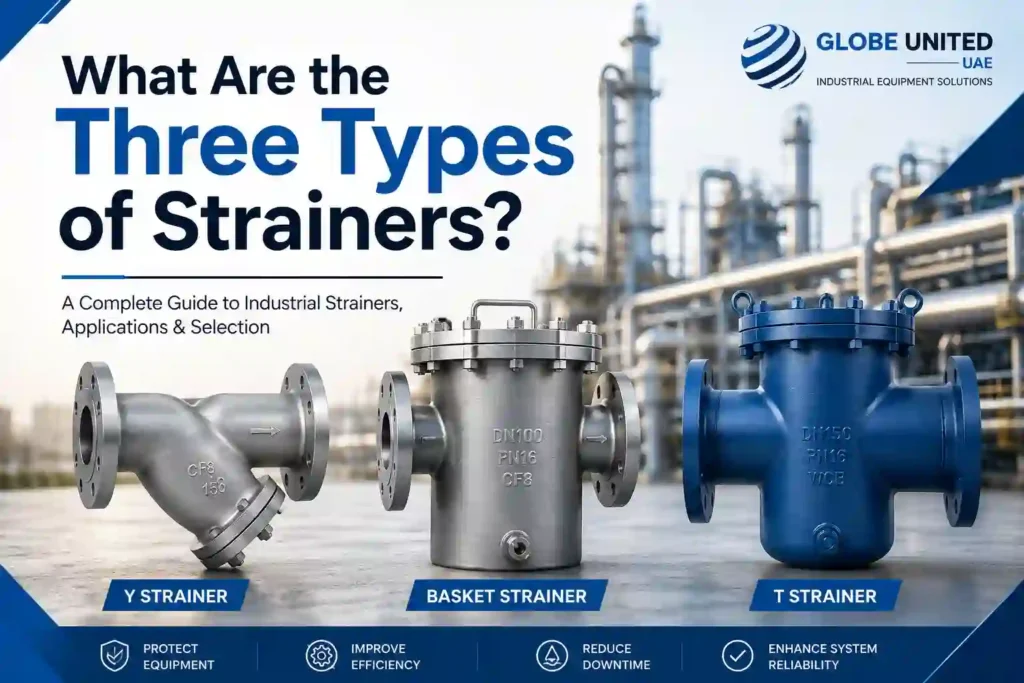
What Are the Three Types of Strainers?
Industrial strainers are one of the most important components in any piping system. They remove unwanted debris such as rust, welding slag, dirt, and other solid particles before these contaminants reach pumps, valves, flow meters, heat exchangers, and other critical equipment. Understanding what are the three types of strainers is essential for engineers, maintenance teams, and procurement professionals looking to improve system reliability and reduce downtime.
Across industries such as oil & gas, water treatment, chemical processing, marine, and manufacturing, selecting the right industrial strainer helps extend equipment life and maintain efficient flow. As a trusted industrial equipment supplier in the UAE, Globe United UAE provides high-quality industrial strainers and pipeline components designed to meet demanding industrial applications.
What Is an Industrial Strainer?
An industrial strainer is a mechanical filtration device installed within a pipeline to capture solid particles while allowing liquids, gases, or steam to pass through with minimal restriction.
Unlike filters that remove very fine contaminants, strainers are designed for mechanical filtration and pipeline protection by intercepting larger debris before it damages downstream equipment.
How It Works
A perforated or mesh screen inside the strainer traps unwanted particles as the process fluid flows through the pipeline. The cleaned fluid continues downstream, while accumulated debris is periodically removed during maintenance.
Why Industrial Strainers Matter
Industrial strainers help:
- Protect pumps and valves from damage
- Prevent blockages in industrial flow systems
- Reduce equipment wear
- Minimize maintenance costs
- Improve process efficiency
- Extend the lifespan of heat exchangers and instrumentation
What Are the Three Types of Strainers?
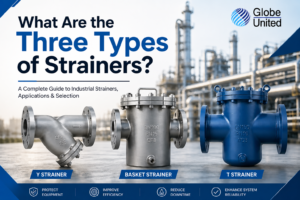
Although many specialized strainers exist, the three most commonly used types of industrial strainers are Y strainers, Basket strainers, and T strainers.
Strainer Type | Design | Best Applications | Advantages |
Y-shaped body | Steam, gas, water lines | Compact, economical, easy installation | |
Basket-style screen | High-flow liquid pipelines | High dirt-holding capacity, easy cleaning | |
T-shaped body | Large industrial systems | Low pressure drop, heavy-duty construction |
1. Y Strainer
The Y strainer is the most widely used pipeline strainer because of its compact design and versatility.
Construction
Its body resembles the letter “Y,” with a removable screen positioned at an angle to the flow path.
Working Principle
As fluid flows through the pipeline, debris is trapped inside the mesh screen while clean fluid continues through the outlet.
Advantages
- Compact installation
- Suitable for horizontal and vertical pipelines
- Cost-effective
- Simple maintenance
- Excellent for steam and gas services
Limitations
- Smaller debris holding capacity
- Requires more frequent cleaning in dirty systems
Common Applications
- Steam pipelines
- Water distribution systems
- Compressed air systems
- Oil transfer lines
- HVAC systems
Industries
- Oil & gas
- Chemical processing
- Power generation
- Manufacturing
2. Basket Strainer
A basket strainer is designed for liquid systems requiring greater debris removal capacity.
Design
It contains a large cylindrical or basket-shaped screen inside a wider body, allowing greater surface area for filtration.
Working Mechanism
Fluid enters the housing and passes through the basket, where contaminants remain inside while clean liquid exits the pipeline.
Benefits
- High dirt-holding capacity
- Lower maintenance frequency
- Suitable for continuous operation
- Excellent flow characteristics
Maintenance
Most basket strainers feature a removable cover, making inspection and cleaning quick and straightforward.
Typical Applications
- Cooling water systems
- Industrial process water
- Chemical transfer
- Food processing plants
- Water treatment equipment
Industries
- Manufacturing
- Marine
- Petrochemical
- Water treatment
- Food & beverage
3. T Strainer
A T strainer is built for larger industrial piping systems where high flow rates and minimal pressure loss are critical.
Construction
Its T-shaped body accommodates larger screens and offers excellent flow distribution.
Features
- Heavy-duty construction
- Large filtration area
- Reduced pressure drop
- High-pressure capability
Advantages
- Longer operating cycles
- Handles high flow volumes
- Suitable for demanding industrial environments
- Supports larger pipeline sizes
Industrial Uses
- Oil and gas filtration
- Petrochemical plants
- Refineries
- Power stations
- Industrial processing facilities
Ideal Operating Conditions
T strainers perform best in systems requiring continuous operation, high flow rates, and minimal interruption for maintenance.
How to Choose the Right Industrial Strainer
Selecting the correct pipeline strainer depends on both process conditions and maintenance requirements.
Selection Factor | Why It Matters |
Fluid Type | Determines body and screen material compatibility |
Flow Rate | Helps size the strainer correctly |
Operating Pressure | Determines pressure rating requirements |
Temperature | Influences material selection |
Particle Size | Determines mesh size |
Maintenance Frequency | Affects cleaning intervals |
Installation Orientation | Ensures proper installation and drainage |
Available Space | Influences strainer design selection |
Industry Standards | Ensures regulatory compliance |
Choosing the appropriate industrial filtration equipment helps reduce downtime, protect valuable assets, and improve overall operational efficiency.
Industries That Use Industrial Strainers
Industrial strainers are essential across numerous sectors:
- Oil & Gas – Protect pumps, valves, and production equipment from debris.
- Petrochemical – Maintain clean process fluids and safeguard critical systems.
- Water Treatment – Remove suspended solids before pumps and treatment equipment.
- HVAC – Prevent blockages in chilled and hot water circulation systems.
- Food Processing – Support hygienic process flow and equipment protection.
- Marine – Filter seawater and cooling systems to reduce equipment wear.
- Power Plants – Protect boilers, condensers, and heat exchangers.
- Pharmaceutical – Maintain clean processing systems and consistent product quality.
- Chemical Plants – Prevent contamination and improve process reliability.
- Manufacturing Industries – Extend equipment life while reducing maintenance costs.
Why Choose Globe United UAE for Industrial Strainers?
Selecting a reliable supplier is just as important as choosing the correct strainer type. Globe United UAE offers a comprehensive range of industrial strainers, valves, pipes, fittings, and engineering solutions tailored to diverse industrial applications across the UAE and GCC.
Customers benefit from quality products, dependable engineering support, competitive pricing, and prompt delivery for industrial projects. Whether the application involves water treatment, manufacturing, marine operations, or oil and gas facilities, Globe United UAE supplies industrial piping components designed for reliable long-term performance.
Conclusion
Understanding what are the three types of strainers helps engineers and procurement teams select the most effective solution for protecting industrial piping systems. Y strainers are ideal for compact installations and steam lines, basket strainers perform exceptionally well in high-flow liquid applications, and T strainers are preferred for large industrial systems requiring low pressure drop and heavy-duty performance.
Choosing the right industrial strainer improves equipment reliability, reduces maintenance costs, and enhances process efficiency. For expert guidance and high-quality industrial strainer solutions, Globe United UAE provides dependable products and technical support for industries throughout the UAE and GCC.
Frequently Asked Questions
- What is the purpose of an industrial strainer?
An industrial strainer removes debris from process fluids to protect pumps, valves, heat exchangers, and other downstream equipment. - Which type of strainer is best for high-flow applications?
Basket strainers are typically the best choice for high-flow liquid applications because of their large dirt-holding capacity and easy maintenance. - What is the difference between a Y strainer and a basket strainer?
A Y strainer has a compact Y-shaped design suited for steam, gas, and general service, while a basket strainer offers a larger filtration area and is better suited for high-flow liquid systems. - Where are T strainers commonly used?
T strainers are commonly installed in refineries, power plants, petrochemical facilities, and large industrial piping systems where low pressure drop and high flow capacity are required. - How often should industrial strainers be cleaned?
Cleaning frequency depends on the fluid type, contaminant load, and operating conditions. Regular inspection and monitoring of pressure drop across the strainer help determine the optimal maintenance interval.