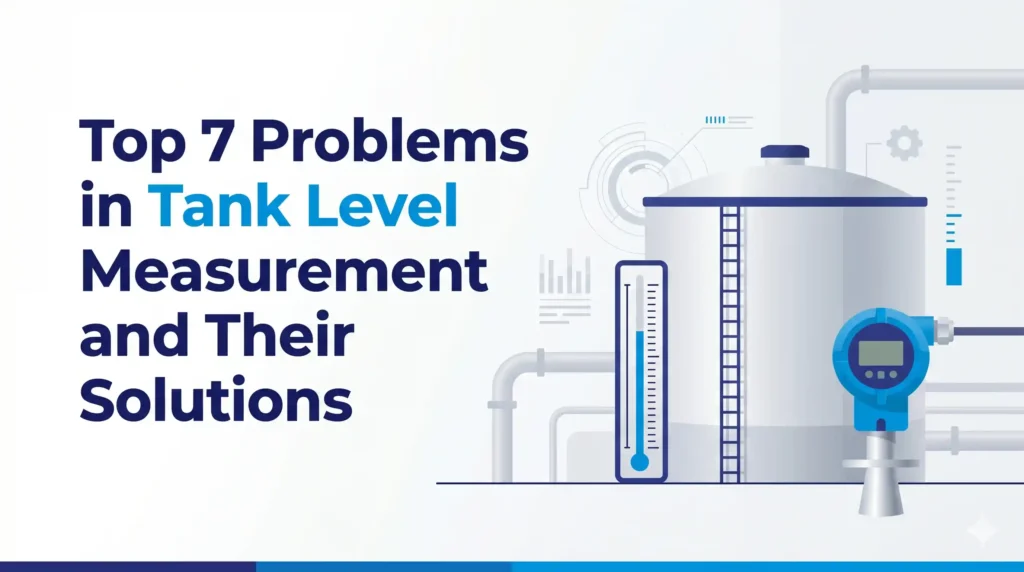
Top 7 Problems in Tank Level Measurement and Their Solutions
Tank level measurement is one of the most critical processes in industrial operations. From oil & gas plants to chemical industries, water treatment facilities, food processing units, and power plants, accurate level monitoring ensures operational efficiency, product quality, and workplace safety.
However, many industries face recurring tank level measurement issues that lead to inaccurate readings, production downtime, overflow incidents, and maintenance challenges. Understanding these common problems and implementing the right solutions can significantly improve process reliability and reduce operational costs.
In this article, we will discuss the top 7 problems in tank level measurement and the most effective solutions used in modern industries.
Why Accurate Tank Level Measurement Matters
Accurate tank level monitoring helps industries:
- Prevent tank overflow and dry running
- Improve inventory management
- Reduce process downtime
- Maintain product consistency
- Enhance plant safety
- Optimize automation systems
Even a small measurement error can lead to major operational and financial losses in industrial environments.
Common Tank Level Measurement Problems and Solutions
Problem | Main Cause | Recommended Solution |
False readings from foam and vapor | Signal interference | Use radar level transmitters |
Inaccurate readings from tank shape | Non-linear geometry | Tank linearization and calibration |
Fluctuating readings | Turbulence and agitation | Use stilling wells or external chambers |
Zero drift and calibration errors | Sensor aging | Regular calibration and maintenance |
Pressure-related measurement errors | Pressurized tanks | Differential pressure transmitters |
Improper sensor installation | Incorrect mounting position | Follow proper installation guidelines |
Corrosion and harsh environments | Aggressive process fluids | Use corrosion-resistant materials |
1. False Readings Caused by Foam and Vapors
One of the most common tank level measurement problems is inaccurate readings caused by foam, vapor, steam, or condensation inside the tank.
This issue is especially common in:
- Chemical processing plants
- Wastewater treatment facilities
- Food and beverage industries
- Oil storage tanks
Ultrasonic level transmitters often struggle because foam absorbs sound waves, while vapor distorts signal transmission. This results in unstable or incorrect level readings.
Solution
Radar level transmitters are highly effective in such applications because they are less affected by foam, vapor, and condensation.
Additional solutions include:
- Installing stilling wells
- Using guide pipes
- Selecting guided wave radar technology
- Applying signal filtering techniques
These methods help stabilize the signal and improve measurement accuracy.
2. Inaccurate Measurements Due to Tank Geometry
Not all industrial tanks have simple vertical cylindrical shapes. Many tanks are:
- Horizontal
- Cone-bottom
- Spherical
- Irregularly shaped
These tank designs create non-linear volume changes, meaning a small level change may represent a large volume variation.
For example, in a horizontal tank, liquid volume changes rapidly in the center section but slowly near the ends.
Solution
Industries can solve this issue by implementing:
- Tank linearization
- Calibration tables
- PLC-based compensation algorithms
- Digital volume mapping systems
Advanced radar transmitters with integrated linearization functions also improve accuracy in irregular tanks.
3. Signal Fluctuation Due to Turbulence and Agitation
Industrial tanks often contain mixers, agitators, pumps, or turbulent filling systems that continuously disturb the liquid surface.
This turbulence causes unstable level signals and fluctuating readings, making process control difficult.
Solution
Several solutions can reduce signal instability:
Recommended Methods
- Install stilling wells
- Use external bypass chambers
- Enable signal damping functions
- Apply averaging filters
- Use guided wave radar transmitters
These methods isolate the sensor from direct turbulence and create more stable level measurement conditions.
4. Zero Drift and Calibration Errors
Over time, many level instruments begin to lose accuracy due to sensor aging and environmental conditions. This problem is known as zero drift.
Common causes include:
- Temperature variation
- Electronic component aging
- Pressure changes
- Improper calibration
- Mechanical wear
Zero drift can create false alarms and inventory mismatches.
Solution
The best way to prevent calibration-related problems is through preventive maintenance.
Best Practices
- Perform scheduled calibration
- Inspect sensors regularly
- Verify transmitter output
- Replace aging components
- Use smart transmitters with diagnostics
Modern digital instruments can automatically detect calibration deviations and notify maintenance teams before failure occurs.
5. Pressure Variations in Pressurized Tanks
Level measurement becomes more challenging in closed or pressurized vessels because internal tank pressure affects the sensor reading.
This issue is common in:
- Steam vessels
- Chemical reactors
- Pressurized storage tanks
- Oil & gas separators
Hydrostatic systems are especially sensitive to pressure changes.
Solution
Differential pressure transmitters are commonly used in pressurized tanks because they compensate for internal vessel pressure.
Additional recommendations include:
- Proper venting systems
- Correct impulse line installation
- Routine pressure balancing checks
- Radar-based non-contact measurement systems
Radar technology is particularly effective because it measures level independently of tank pressure.
6. Improper Sensor Installation
Even high-quality level instruments can fail if they are installed incorrectly.
Common installation mistakes include:
- Mounting near agitators
- Positioning near inlet pipes
- Ignoring sensor dead zones
- Improper nozzle alignment
- Obstructions blocking the signal path
These issues often lead to weak signal reflection and unstable readings.
Solution
Proper installation planning is essential for long-term measurement reliability.
Installation Guidelines
Installation Factor | Best Practice |
Sensor Position | Away from turbulence |
Alignment | Perpendicular to liquid surface |
Obstructions | Avoid internal structures |
Mounting Height | Follow manufacturer guidelines |
Sensing Range | Stay within recommended limits |
Following manufacturer installation recommendations significantly improves sensor performance.
7. Corrosion and Harsh Process Conditions
Industrial tanks frequently contain corrosive chemicals, abrasive slurries, or high-temperature fluids that damage sensors over time.
Corrosion can affect:
- Sensor diaphragms
- Process connections
- Probe materials
- Cable insulation
This results in premature equipment failure and inaccurate readings.
Solution
Selecting the correct material for the application is extremely important.
Common Corrosion-Resistant Materials
Material | Suitable Applications |
Stainless Steel | General industrial use |
PTFE | Chemical applications |
Hastelloy | Highly corrosive environments |
PVDF | Acidic process fluids |
Ceramic Coating | Abrasive slurry applications |
Non-contact radar transmitters are also widely used because they minimize direct exposure to harsh process conditions.
Tank level measurement problems can lead to serious operational inefficiencies, safety risks, and maintenance expenses if not addressed properly. Issues such as foam interference, turbulence, pressure variation, calibration drift, and corrosion are common across industrial environments.
The key to reliable level measurement lies in:
- Choosing the correct technology
- Ensuring proper installation
- Performing regular maintenance
- Using application-specific materials
Modern solutions such as radar level transmitters, guided wave radar systems, stilling wells, external chambers, and smart diagnostic instruments help industries achieve accurate and reliable tank monitoring even in the most challenging process conditions.
Looking for reliable and accurate Tank Level Measurement Solutions for your industrial applications? Globe United UAE provides advanced level measurement systems, process instrumentation solutions, and customized industrial products designed for maximum performance and reliability.
Whether you need solutions for oil & gas, chemical processing, water treatment, or industrial automation, our experts are ready to help you choose the right instrumentation for your application.
📧 info@globeunitedae.com
🌐 globeunitedae.com
📞 +971 65585309